Running a calm
four-hour session
Most of what makes an evening work has nothing to do with the cards. It is light, seating, where the drinks are, and how quickly a disagreement gets smaller instead of larger.
Before people arrive
A room that lets people see.
Cards are small, dense objects with fine print. A room that is pleasant for conversation is often too dim for card text, and the resulting squinting is what makes a session feel tiring.
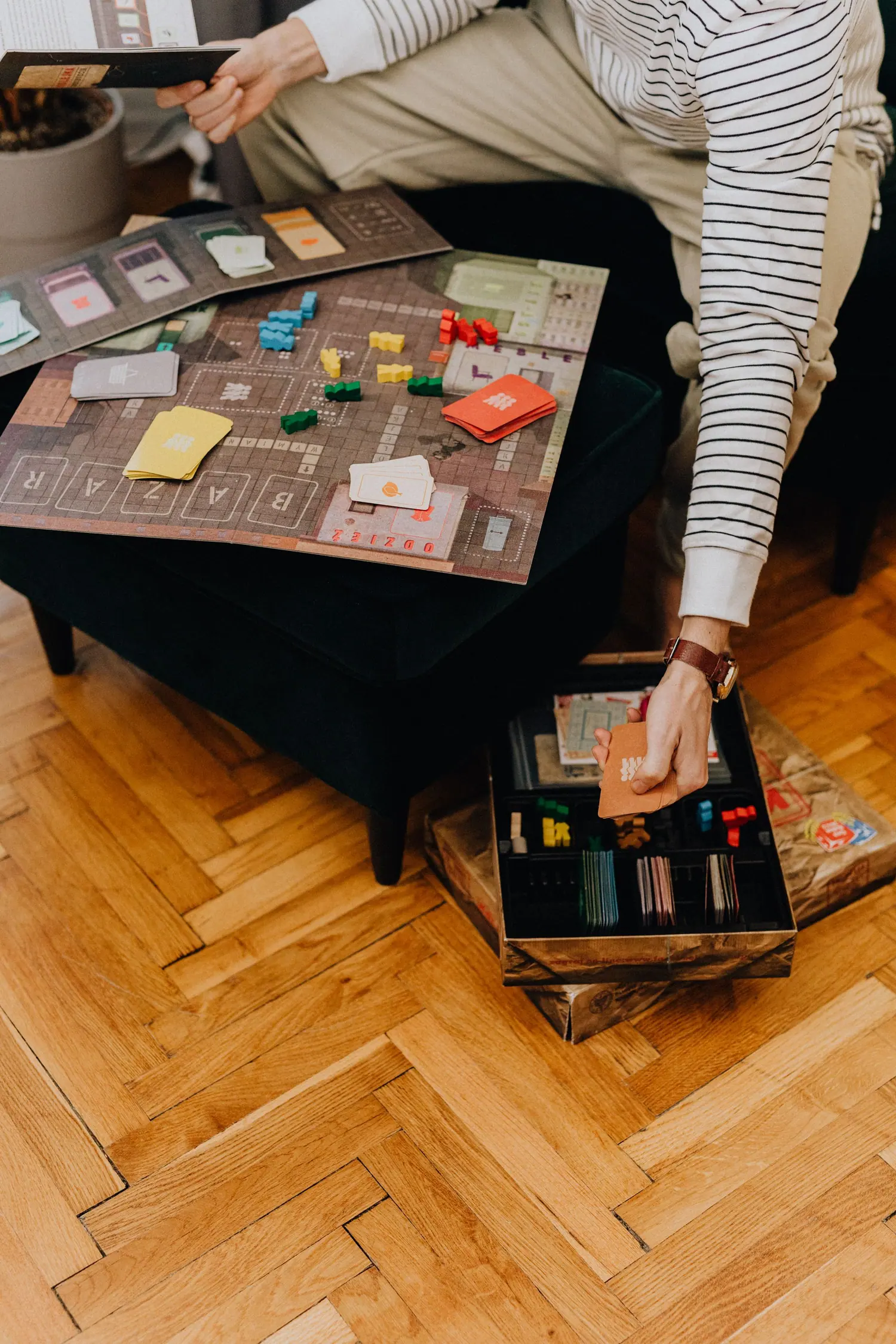
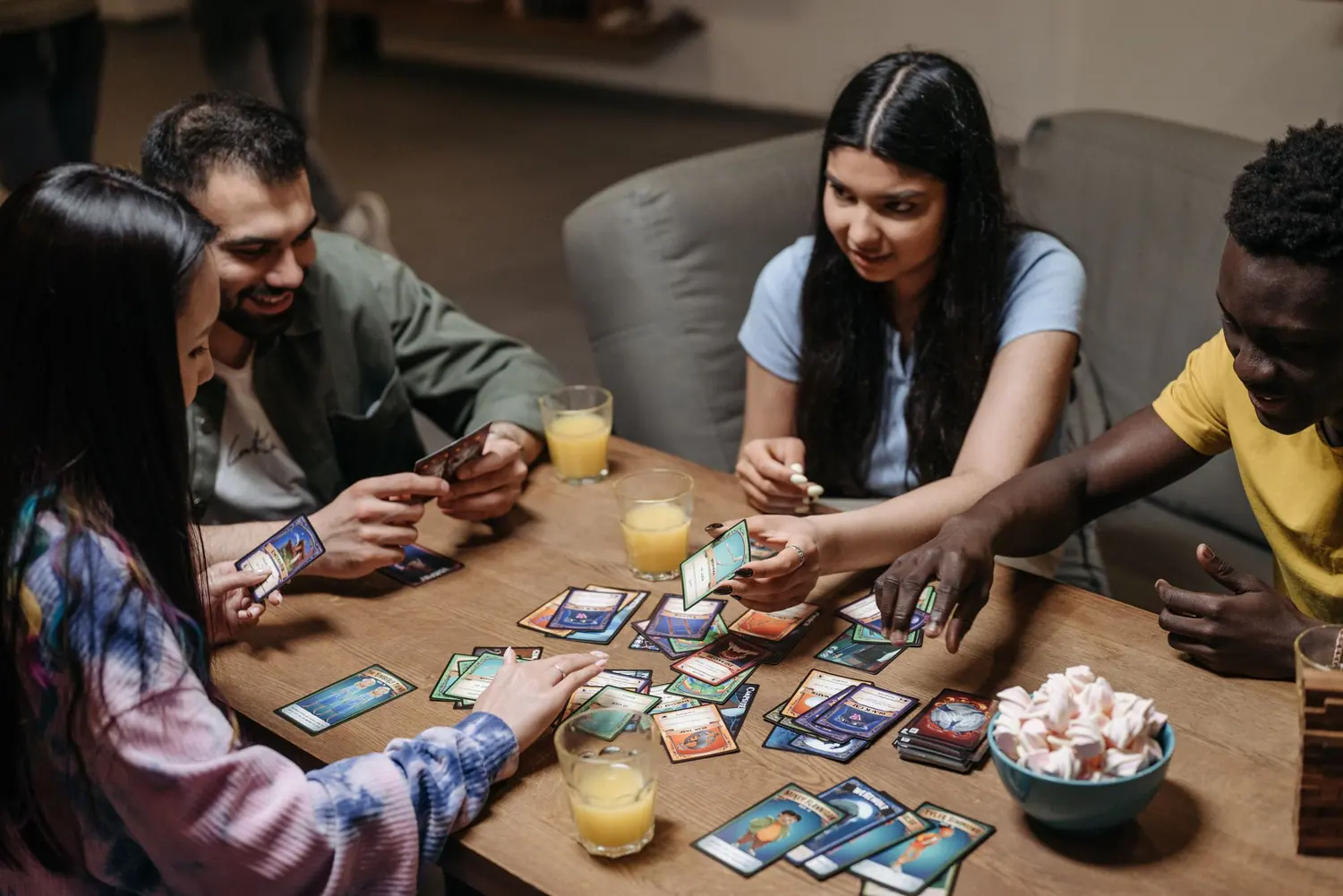
A card night is a small piece of event design. Four hours is long enough that small frictions accumulate: a glare on the table, a chair that is too low, a glass that keeps getting moved away from the edge. None of these are dramatic, and all of them shape whether people want to come back.
Light
Two requirements pull in different directions. You need enough light on the table to read small text, and you want no direct glare on the card surfaces. A single overhead pendant directly above the table is the worst of both: bright enough to see, and positioned to bounce straight into everyone's eyes off a glossy card.
The practical fix is diffuse light from more than one direction, with the sources above and slightly behind the seated players rather than in front of them. A floor lamp on each side of the table does more than a brighter ceiling light. If the room has a dimmer, use it: slightly warm and slightly dim is easier on everyone than bright and cool.
Seating and table space
Each player needs roughly an arm's length of table edge. Less than that and the evening becomes a series of small collisions: elbows, sleeves, cards knocked sideways. If the table is tight, seat fewer people rather than compressing everyone. A four-person game at a comfortable table is better than a six-person game where nobody can lay out their cards.
Chair height matters more than people expect. If the table is high and the chairs are low, players end up leaning over their cards, which obscures them and makes the surface a target for hair, sleeves and breath. A cushion under a low chair is a cheap and effective adjustment.
A soft, clean cloth is kinder to card edges than bare wood or stone, and it stops cards sliding when the table is bumped. Avoid textured or gritty surfaces entirely: they act like sandpaper on card edges over an evening.
Drinks, and where they live
This is the single highest-value decision of the evening. Put drinks on a side table, not the play table. Not because anyone is careless, but because a full glass next to loose cards is a permanent low-grade risk that everyone is unconsciously managing.
If a side table is impossible, use vessels with lids and place them at the far edge, behind each player's card area rather than beside it. Never between two players — that is where hands travel most.
Pace and breaks
Four hours without a break is longer than it feels. A short pause at the two-hour mark — five or ten minutes, everyone stands up — resets attention and prevents the last hour from becoming sloppy. Sloppy play is where most rules arguments begin, because nobody is reading carefully any more.
If a game is running long and clearly will not finish, say so at a natural boundary and agree to end it there. A game stopped cleanly and discussed afterwards is more satisfying than one that is abandoned in frustration at midnight.
The goal of the evening is that everyone wants to do it again, not that the game reached a conclusion.
When people disagree
Disagreements about a card's text are normal and usually brief. What turns them into friction is the format: two people restating their position with increasing confidence, neither looking at the card.
A simple protocol defuses almost all of them. First, both players stop and the card is placed in the middle of the table where everyone can see it. Second, the text is read aloud in the five-part order described in Reading rules text closely — cost, type, timing, effect, restriction. Third, if the disagreement survives that, look up the official ruling rather than continuing to argue.
Helps
- Card placed in the centre, visible to all
- Text read aloud, in order
- One person designated to look things up
- Agreeing to move on and check later
Makes it worse
- Repeating a position more firmly
- Arguing from memory of a different card
- Appeals to who has played longer
- Continuing while someone is clearly tired
If someone is new
A newcomer in a group of experienced players is a design problem, not a knowledge problem. The easiest fix is a first game with an open hand: everyone plays with cards visible, and the experienced players narrate their reasoning as they go. It is slower, and it teaches more in one game than an hour of explanation.
Also resist the urge to lend a complex deck. A straightforward deck that a newcomer can understand and operate is a better first experience than a powerful one they cannot pilot.
Afterwards
Ten minutes of tidying, done together, prevents almost all storage problems. Cards go back into sleeves before they go back into boxes; drinks are cleared first; the table is wiped before anything is laid on it again. If someone's cards went home loose in a pocket, mention it kindly and once.
Revision notes
12 September 2026 — Expanded the disagreement protocol and added the note on playing with an open hand for newcomers.
22 May 2026 — First publication.
These are hosting suggestions, not rules for any game. Organised play, venue requirements and conduct policies are set by the organisers and publishers involved.